Media
See Myra in action.
Infographic, walkthroughs, and a deep dive into the compiler architecture.
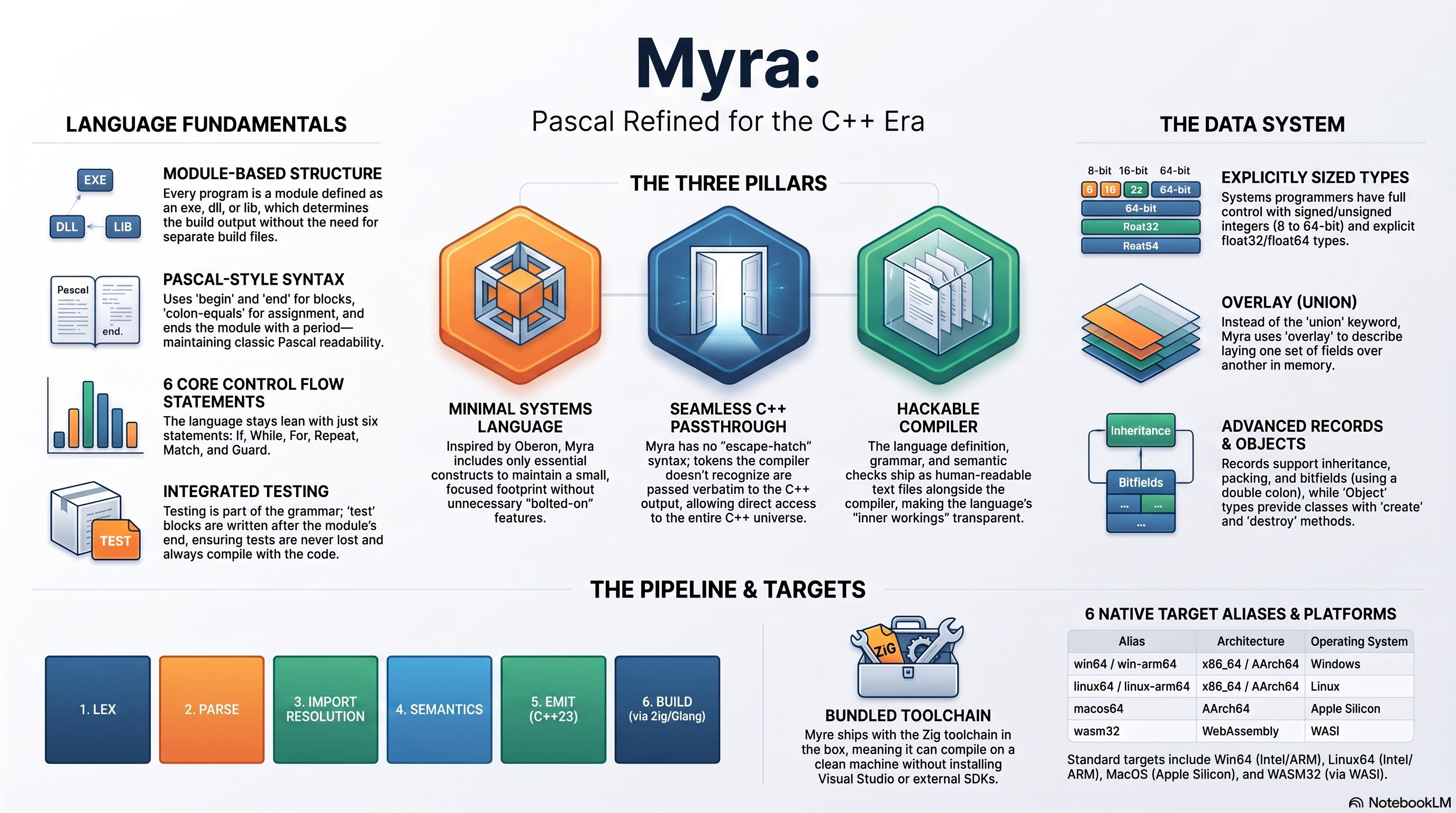
Deep Dive -- Compiler Architecture
Use the expand button to view full size
The Myra Programming Language
C++ is always one line away.
A systems programming language in the Pascal/Oberon tradition.
Compiles to C++23 via Zig/Clang. Six targets from one source --
Windows, Linux, macOS, ARM64 and WebAssembly.
The language definition ships as readable .mld files
you can inspect, patch, and extend.
module exe hello;

type
  Color = choices(Red, Green, Blue);
  Point = record
    x: int32;
    y: int32;
  end;

routine greet(const name: string);
begin
  println("Hello, {}!", name);
end;

var
  p: Point;

begin
  @ifdef TARGET_WIN64
  greet("Windows");
  @else
  greet("Linux");
  @endif

  p.x := 42;  p.y := 99;
  println("({}, {})", p.x, p.y);
end.
Core strengths
Oberon-inspired minimalism. Only the constructs that earn their place.
Compiles to real machine code via C++23. No VM, no garbage collection pauses. Decades of compiler optimisation work, for free.
#include any C++ header, use std::vector, call std::sqrt, mix new/delete with Myra's create/destroy. If it's not a Myra keyword, it's C++.
The language definition ships as readable .mld files. Fix a compiler bug. Add a keyword. Change code generation. The language is yours to shape.
Records with inheritance and bit fields. Objects with virtual dispatch. Overlays. Typed sets. Fixed and dynamic arrays. Pointer types. Routine types.
Windows, Linux, macOS, ARM64 and WebAssembly from the same file. Conditional compilation with @ifdef TARGET_WIN64. Zig handles every cross-compile; wasm builds run straight in the browser.
test "name" begin...end; blocks live in the same source file. Typed assertions (testAssertEqualInt, testAssertTrue, etc.) with file and line reporting.
Language tour
Every example below compiles and runs. No hand-waving.
// Overloading -- same name, different signatures
routine max(const a: int32; const b: int32): int32;
begin
  if a > b then return a; end;
  return b;
end;

routine max(const a: float64; const b: float64): float64;
begin
  if a > b then return a; end;
  return b;
end;

// var parameter -- modified in place
routine swap(var a: int32; var b: int32);
var
  tmp: int32;
begin
  tmp := a;  a := b;  b := tmp;
end;

// Recursion
routine fib(const n: int32): int32;
begin
  if n <= 1 then return n; end;
  return fib(n - 1) + fib(n - 2);
end;
type
  Point = record
    x: int32;
    y: int32;
  end;

  // Record inheritance
  Point3D = record(Point)
    z: int32;
  end;

  // Packed -- no padding between fields
  Header = record packed
    magic:   uint32;
    version: uint16;
    flags:   uint8;
  end;

  // Bit fields
  Flags = record packed
    active: uint8 : 1;
    mode:   uint8 : 3;
    level:  uint8 : 4;
  end;

var
  p: Point3D;

begin
  p.x := 10;  p.y := 20;  p.z := 30;
  println("({}, {}, {})", p.x, p.y, p.z);
end.
type
  TAnimal = object
    Name_: string;

    method Init(AName: string);
    begin
      self.Name_ := AName;
    end;

    method Speak();
    begin
      println("{} says: ...", self.Name_);
    end;
  end;

  TDog = object(TAnimal)
    // Override -- virtual dispatch
    method Speak();
    begin
      println("{} says: Woof!", self.Name_);
    end;
  end;

var
  dog: pointer to TDog;
  base: pointer to TAnimal;

begin
  create(dog);
  dog.Init("Buddy");

  // Dispatch through base pointer
  base := pointer to TAnimal(dog);
  base.Speak();  // calls TDog.Speak()
  destroy(dog);
end.
routine getZero(): int32;
begin
  return 0;
end;

var
  x: int32;

begin
  // Software exception
  guard
    raiseexception("Something went wrong");
  except
    println("Caught: {}", getexceptionmessage());
  end;

  // With error code and finally
  guard
    raiseexceptioncode(42, "Custom error");
  except
    println("Code: {}", getexceptioncode());
  finally
    println("Always runs");
  end;

  // Hardware exception (div-by-zero)
  guard
    x := 10 div getZero();
  except
    println("HW exception: {}", getexceptionmessage());
  end;
end.
// User-defined variadic routine
routine sumInts(...): int32;
var
  i: int32;
  sum: int32;
  arg: int32;
begin
  sum := 0;
  for i := 0 to varargs.count - 1 do
    arg := varargs.next(int32);
    sum := sum + arg;
  end;
  return sum;
end;

begin
  println("sum = {}", sumInts(10, 20, 30));   // 60
  println("sum = {}", sumInts(1, 2, 3, 4, 5)); // 15
  println("sum = {}", sumInts());             // 0
end.
var
  s1: set;
  s2: set;
  s3: set;

begin
  s1 := [1, 3, 5];     // bit positions 1, 3, 5
  s2 := [3, 5, 10];

  // Set arithmetic
  s3 := s1 + s2;  // union: [1,3,5,10]
  s3 := s1 * s2;  // intersection: [3,5]
  s3 := s1 - s2;  // difference: [1]

  // Membership test
  if 1 in s1 then
    println("1 is in s1");
  end;

  // Range literal
  s1 := [1..5];   // bits 1 through 5
end.
module exe ffi_demo;

// Per-target library paths -- TARGET_* is defined by the compiler
@ifdef TARGET_LINUX64
@copydll "output/zig-out/lib/libmathlib.so";
@librarypath "output/zig-out/lib";
@elseif TARGET_WIN64
@librarypath "output/zig-out/bin";
@endif

@linklibrary "mathlib";

// clink = C linkage (extern "C", unmangled). cpplink is the default.
routine clink add(const a: int32; const b: int32): int32; external "mathlib";
routine clink quadruple(const x: int32): int32; external "mathlib";

// Variables can be imported too
var version: int32; external "mathlib";

var
  r: int32;

begin
  r := add(3, 5);
  println("add(3, 5) = {}", r);
  println("quadruple(4) = {}", quadruple(4));
  println("lib version = {}", version);
end.
module exe mixed;

// C++ headers pass through verbatim
#include <cmath>
#include <string>
#include <vector>

var
  LS: std::string;
  LV: std::vector<int32_t>*;

begin
  // C++ functions in Myra expressions
  println("sqrt(16) = {}", std::sqrt(16.0));

  // C++ types as Myra variables
  LS := "hello from C++";
  println("len = {}", LS.length());

  // C++ new/delete alongside Myra
  LV := new std::vector<int32_t>();
  LV->push_back(42);
  println("size = {}", LV->size());
  delete LV;
end.
Cross-platform
The same Myra source compiles to Windows, Linux, macOS, ARM64 and WebAssembly.
The compiler defines a TARGET_* symbol for the active target, so
@ifdef TARGET_WIN64 handles the differences. Zig performs every
cross-compile -- there is no second toolchain to install.
TARGET_* symbols injected automaticallyModule system
Every Myra source file is a module. The kind declaration determines the output artifact.
A program with a begin..end. entry point. Produces a native executable. The most common module kind.
Compiled to .lib (Windows) or .a (Linux). Use exported to expose symbols. Importable with import.
Compiled to .dll or .so. Export C-compatible APIs with exported routine clink. Ideal for plugins and FFI.
Vendor modules
The compiler knows about exactly one library path: the standard library. Everything else carries its own build configuration. Dropping in a new dependency requires zero compiler changes.
module lib raylib_import;

// It owns every path it needs.
// The langdef knows nothing about raylib.
@includepath "res/libs/vendor/raylib/include";

@ifdef TARGET_WIN64
  @librarypath "res/libs/vendor/raylib/win64/bin";
  @copydll "res/libs/vendor/raylib/win64/bin/raylib.dll";
@elseif TARGET_LINUX64
  @librarypath "res/libs/vendor/raylib/linux64/bin";
@endif

@linklibrary "raylib";

#include "raylib.h"

end.
module exe game;

// Name where it lives, then import it.
// That is the whole integration.
@modulepath "res/libs/vendor/raylib";

import
  raylib_import;

const
  CScreenWidth  = 800;
  CScreenHeight = 450;

begin
  InitWindow(CScreenWidth, CScreenHeight, "Raylib Window");
  SetTargetFPS(60);

  while not WindowShouldClose() do
    BeginDrawing();
      ClearBackground(RAYWHITE);
    EndDrawing();
  end;

  CloseWindow();
end.
Media
Infographic, walkthroughs, and a deep dive into the compiler architecture.
"Start with Pascal. Remove everything that is not essential."
-- The Myra design principle